NCLEX Practice Exam 8
Practice exam 8 is a full 30-question NCLEX-RN sitting in the Next Generation format. It mixes stand-alone items (an arteriovenous fistula, colorectal screening, a fentanyl patch, colostomy care, insulin peak times, arterial blood gases, a weight-based pediatric dose, bladder irrigation after TURP, and START triage) with one six-question case study: Karl Brennan, 56, after a fall and ankle surgery, when the 2200 findings point to alcohol withdrawal. The case follows the six clinical judgment steps, from recognizing cues to evaluating outcomes, with the medical record open beside each question.
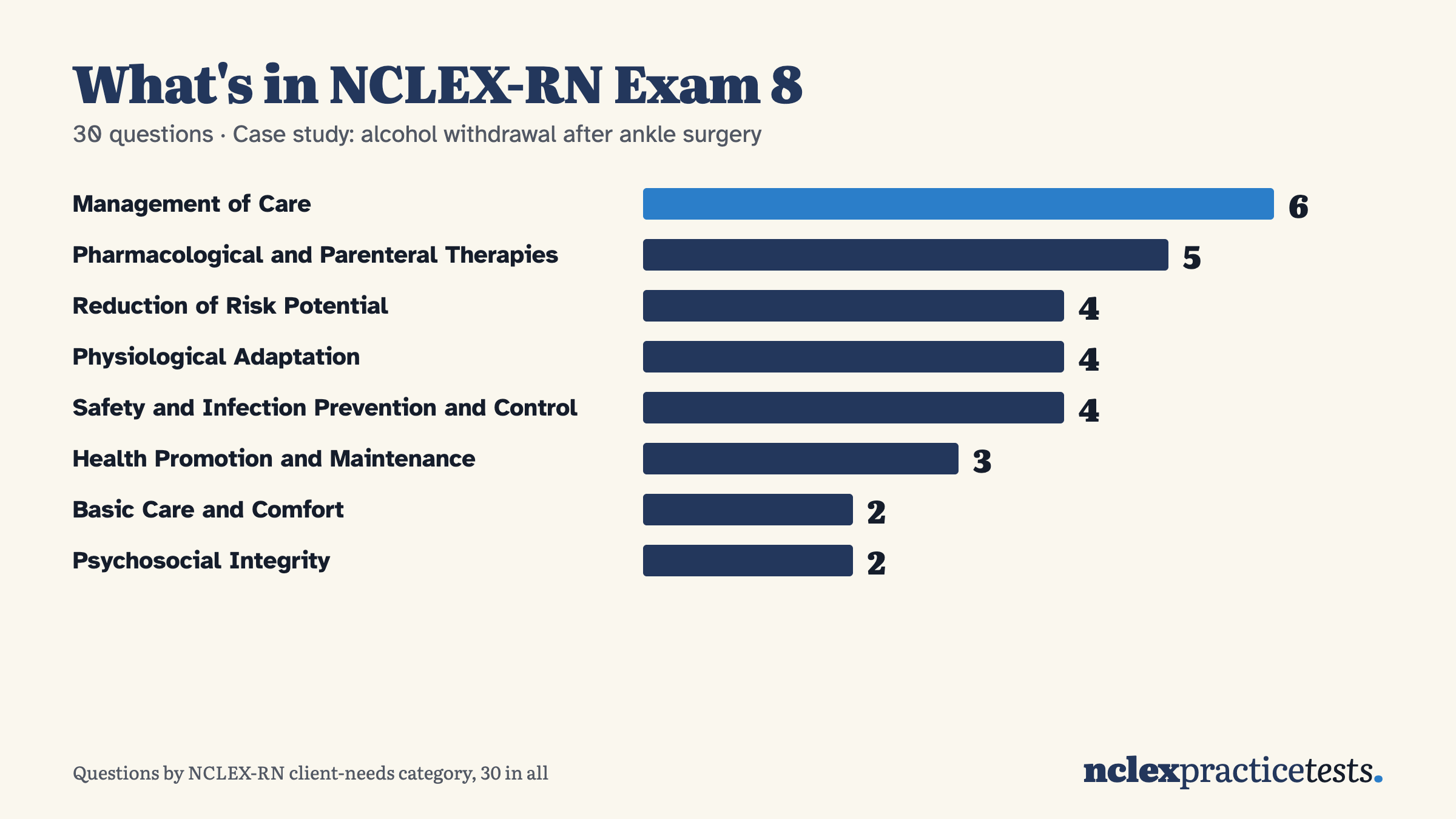
Every question is original and spread across the eight client-needs categories of the NCSBN test plan, so your results show which areas need work.
- 30 original questions, with the answer and a reason for every choice
- Study mode shows the rationale as you go; timed mode gives you 60 minutes
- 7 question types: one best answer, select all that apply, matrix, drop-down cloze, highlight, trend, bowtie
- Case study: alcohol withdrawal after ankle surgery, 6 questions with a medical record
- Free, no sign-up. Your score breaks down by client-needs category at the end.
NCLEX-RN Exam 8
Item types on this form: one best answer, select all that apply, matrix, drop-down, highlight, trend, bowtie, and a charted case. Not an official NCLEX exam and not affiliated with NCSBN or Pearson VUE.
All 30 questions in NCLEX-RN Exam 8
Taking the form with the Start button above, timed, gives you the truest read. To study instead, work through the same questions here: the answer and the reason for every choice are folded under each one.
A client had a left forearm arteriovenous fistula created 2 weeks ago for future hemodialysis. Yesterday the nurse felt a thrill and heard a bruit over it. This morning the nurse can feel no thrill and hear no bruit. What should the nurse do?
- ATell the client the thrill often fades while a new fistula matures
- BHave the client squeeze a soft ball to bring back the blood flow
- CDocument the findings and reassess the fistula at the end of the shift
- DNotify the provider promptly, because the fistula may have clotted
Show answer and reasons
- WrongThrill fades as it matures. A maturing fistula gets a stronger thrill and bruit, not a weaker one. Losing both is a warning sign, not a normal stage.
- WrongSqueeze a ball. Hand exercises can help a working fistula mature, but they will not open a clotted one. Using them instead of reporting delays treatment.
- WrongReassess later. Waiting hours lets a clot set and makes the fistula less likely to be saved. The change from yesterday needs reporting now.
- CorrectNotify the provider. The thrill and bruit come from blood flowing from the artery into the vein. When both are gone, the fistula has likely clotted. Prompt treatment may save it, so the nurse reports right away.
A 46-year-old client with no personal or family history of colorectal cancer or polyps asks when to start colorectal cancer screening. Which response by the nurse is accurate?
- A"Screening is recommended starting at age 45, so it is time to begin now."
- B"Screening is needed only if you notice blood in your stool."
- C"Screening starts at age 50 for people with no family history."
- D"A colonoscopy is the only test recommended for screening."
Show answer and reasons
- CorrectBegin at 45. Current US guidance advises adults at average risk to begin colorectal cancer screening at age 45. This client is 46 and is due now.
- WrongOnly with blood in stool. Screening is meant for people without symptoms. Blood in the stool is a symptom that needs a diagnostic workup, not screening.
- WrongStart at 50. Age 50 was the older starting age. The recommended age was lowered to 45 because colorectal cancer is being found more often in younger adults.
- WrongColonoscopy only. Several tests are accepted for screening, including stool-based tests and colonoscopy. The client can choose with the provider.
A client with cancer pain is starting a fentanyl transdermal patch at home. Which statement by the client shows a need for more teaching?
- A"I will put a heating pad over the patch when my back pain flares up."
- B"I will press the new patch in place for 30 seconds on clean, dry skin."
- C"I will put each new patch on a different spot than the one before it."
- D"I will fold the old patch in half, sticky sides together, to throw it away."
Show answer and reasons
- CorrectHeating pad. Heat speeds up how fast fentanyl passes through the skin. A heating pad, electric blanket or hot tub over the patch can cause an overdose with dangerously slow breathing. The client needs to avoid heat over the patch and report fever.
- WrongPress for 30 seconds. The client has this step down. Firm pressure on clean, dry, unbroken skin helps the patch stick so the dose is delivered evenly.
- WrongRotate sites. The client has this step down. Using a new spot each time lets the skin under the last patch recover and limits irritation.
- WrongFold sticky sides together. The client has this step down. A used patch still holds enough fentanyl to harm a child or pet, so it is folded sticky sides together and then flushed or disposed of the way the label and pharmacist direct.
A client with left-sided weakness of the face and body after a stroke passed a swallow evaluation and is cleared for a soft diet with thickened liquids. The nurse is helping the client eat lunch. Which action is appropriate?
- AOffer the thickened liquids through a straw between bites
- BLower the head of the bed so the client can rest after lunch
- CTilt the client's head back slightly with each swallow
- DPlace small bites of food on the right side of the client's mouth
Show answer and reasons
- WrongStraw. A straw delivers liquid fast and is harder to control, which raises the risk of aspiration. Clients with dysphagia usually drink from a cup unless the speech-language pathologist says otherwise.
- WrongHead of bed lowered after eating. The client should stay upright for at least 30 minutes after a meal so food that lingers in the throat does not get aspirated.
- WrongHead tilted back. Tilting the head back opens the airway and lets food slide in before the swallow is ready. A slight chin tuck, if the swallow plan calls for it, protects the airway instead.
- CorrectRight side of the mouth. The right side is the side with normal strength and feeling, so the client can move the food and sense it there. Small bites lower the risk of food pocketing in the weak cheek or going into the airway.
A client has a new descending colostomy. The stoma is pink and moist and measures 30 mm (about 1 1/4 inches) across. The nurse is preparing a new cut-to-fit skin barrier and pouch. How should the nurse size the opening in the barrier?
- ACut it about 2 to 3 mm (1/16 to 1/8 inch) larger than the stoma
- BCut it about 2.5 cm (1 inch) larger than the stoma so it has room to swell
- CCut it exactly the size of the stoma so that no skin shows
- DCut it slightly smaller than the stoma so the barrier seals tightly
Show answer and reasons
- Correct2 to 3 mm larger. A small margin lets the stoma move and swell without rubbing while leaving very little skin exposed to stool. A new stoma shrinks over the first weeks, so it is measured again at each change.
- Wrong1 inch larger. A wide gap leaves a ring of skin exposed to stool, which breaks the skin down and can loosen the seal.
- WrongExactly the stoma size. A stoma swells and changes shape with peristalsis. An opening cut to the exact size can rub and cut into it.
- WrongSmaller than the stoma. An opening smaller than the stoma squeezes it, which can injure the tissue and reduce its blood supply.
A client at 28 weeks of gestation in her second pregnancy says, "I got the whooping cough shot when I was pregnant 2 years ago, so I don't need it this time." Which response by the nurse is best?
- A"Your baby will get the shot at birth instead, and that works better than a dose now."
- B"That is right. A dose in one pregnancy protects you and your future babies for 10 years."
- C"The shot is advised in every pregnancy, best between 27 and 36 weeks."
- D"It is safer to wait and get the shot after the birth, before you go home."
Show answer and reasons
- WrongGiven to the baby at birth. Babies start their own whooping cough vaccine series at 2 months. Until then, the antibodies passed on during pregnancy are their main protection.
- WrongProtected for 10 years. The 10-year booster schedule is for adults who are not pregnant. One dose does not give enough antibody to protect babies in later pregnancies.
- CorrectEvery pregnancy, 27 to 36 weeks. Antibodies from the Tdap vaccine fade, so it is given in each pregnancy. A dose early in the 27 to 36 week window passes the most antibody to the baby before birth.
- WrongAfter the birth. A dose after birth protects the parent but passes no antibody to the baby across the placenta. It is given after birth only to someone who has never had Tdap.
A client with type 1 diabetes asks when each of the insulins on the medication list is most likely to cause a low blood glucose. For each insulin, specify the usual time of peak action after a subcutaneous injection.
About 1 hour 2 to 4 hours 4 to 12 hours No pronounced peak Insulin glargine NPH insulin Insulin lispro Regular insulin Show answer and reasons
- CorrectGlargine: no pronounced peak. Glargine is a long-acting basal insulin released slowly over about 24 hours with no pronounced peak. That steady level is why it covers the body's background needs and rarely causes a sudden low.
- CorrectNPH: 4 to 12 hours. NPH is cloudy, intermediate-acting insulin that is absorbed slowly. It peaks about 4 to 12 hours after the injection, so a morning dose can cause a low in the afternoon if lunch is skipped.
- CorrectLispro: about 1 hour. Lispro is rapid-acting. It starts within about 15 minutes and peaks in about 1 hour, so a low is most likely soon after a meal dose. A peak at 2 to 4 hours would describe the slower regular insulin.
- CorrectRegular: 2 to 4 hours. Regular insulin is short-acting. It starts in about 30 minutes and peaks about 2 to 4 hours after the injection, which is why it is given about 30 minutes before a meal.
At 0215 the nurse finds a client sitting on the floor beside the bed. After assessing the client and helping the client back to bed, the nurse writes a note in the medical record. Which entry is appropriate?
- AClient fell out of bed while trying to reach the bathroom. No injury noted. Incident report completed.
- BFound sitting on floor beside bed. Most likely slipped because of the sleeping pill given at 2200. No injury noted.
- CFound sitting on floor beside bed. Bed alarm was off because the night aide did not turn it on. No injury noted.
- DFound sitting on floor beside bed. States, "I slipped going to the bathroom." No injury noted. Provider notified.
Show answer and reasons
- WrongFell out of bed; incident report. No one saw the client fall, so the note should not say how it happened. The incident report is an internal quality record and is not mentioned in the medical record.
- WrongGuesses the cause. The nurse did not see the fall, so blaming the sleeping pill is speculation. The note records findings, and the cause is left to follow-up review.
- WrongBlames the aide. Blaming a coworker does not belong in the medical record. Equipment and staffing problems go in the incident report, where they can be reviewed.
- CorrectFacts and the client's own words. The note states what the nurse found, quotes what the client said, gives the assessment result and records who was notified. It is factual and does not guess at the cause.
Medical record for this case
History and Physical
Karl Brennan, 56 years old. Admitted Saturday evening after a fall from a ladder at home. Open reduction and internal fixation of a right ankle fracture on Sunday morning. Weight 82 kg (181 lb).
History: hypertension, takes amlodipine 5 mg daily. Told the admitting nurse he drinks "a few beers on weekends." No known drug allergies.
Orders since surgery: morphine 2 mg IV every 3 hours as needed for pain, enoxaparin 40 mg subcutaneously daily, amlodipine 5 mg by mouth daily. IV: saline lock in the left forearm.
Nurses' Notes
Monday 0800: Alert and oriented to person, place and time. Ankle pain 3 out of 10.
Monday 2200 (postoperative day 1): His wife called at 2130 and said he drinks 8 to 10 beers every day and had his last drink Saturday afternoon, before the fall.
Restless, picking at the bed sheets, and says there are bugs crawling on the blanket. Hands shake when he reaches for his water cup. Sweating heavily, with his gown damp. Oriented to person only and thinks he is at work. Last morphine dose at 1600 for ankle pain 4 out of 10. Right toes warm and pink, capillary refill under 3 seconds, moves toes on request. Surgical dressing dry and intact.
Vital Signs
Monday 0800 Temperature 37.0°C (98.6°F) Heart rate 88 Respiratory rate 16 Blood pressure 138/84 Oxygen saturation 97% on room air
Monday 2200 Temperature 38.1°C (100.6°F) Heart rate 124 Respiratory rate 24 Blood pressure 172/100 Oxygen saturation 96% on room air
Laboratory Results
Monday 0600 Glucose 104 mg/dL Sodium 137 mEq/L Potassium 3.6 mEq/L Magnesium 1.2 mg/dL BUN 14 mg/dL Creatinine 0.9 mg/dL AST 96 units/L ALT 52 units/L Hemoglobin 13.4 g/dL White blood cells 9,200/mm³
Monday 2200 Bedside glucose 112 mg/dL
The nurse reviews the 2200 note. Select the findings that require immediate follow-up. Select all that apply.
- ARestless, picking at the bed sheets, and says there are bugs crawling on the blanket.
- BHands shake when he reaches for his water cup.
- CSweating heavily, with his gown damp.
- DOriented to person only and thinks he is at work.
- ELast morphine dose at 1600 for ankle pain 4 out of 10.
- FRight toes warm and pink, capillary refill under 3 seconds, moves toes on request.
- GSurgical dressing dry and intact.
Show answer and reasons
- CorrectPicking, seeing bugs. Restlessness, picking at the sheets and seeing bugs that are not there are new. Visual hallucinations point to a serious change in his brain function.
- CorrectShaking hands. A tremor that shows when he reaches for something is a classic sign of alcohol withdrawal, from an overactive nervous system once alcohol is gone.
- CorrectHeavy sweating. Heavy sweating, with his heart rate of 124 and pressure of 172/100 at 2200, shows autonomic overactivity. It also raises his fluid losses.
- CorrectOriented to person only. He was alert and oriented at 0800. New disorientation is delirium, and it puts him at risk of falls, pulling out his IV and injuring the repaired ankle.
- WrongPain 4 out of 10 at 1600. Moderate pain treated 6 hours ago is expected the day after surgery. The low dose 6 hours ago does not explain agitation or hallucinations.
- WrongToes warm and pink. Normal color, warmth, refill and movement show good circulation and nerve function below the repair. There is no sign of compartment syndrome.
- WrongDressing dry. A dry, intact dressing shows no bleeding or drainage from the incision.
Complete the sentence.
The nurse analyzes the record. The client's findings are most consistent with ____.
- 1Aopioid toxicity
- 1Balcohol withdrawal delirium
- 1Chypoglycemia
- 2Amade riskier by his low sodium level
- 2Bmade riskier by his low potassium level
- 2Cmade riskier by his low magnesium level
Show answer and reasons
- WrongOpioid toxicity. Too much opioid slows the brain and breathing: drowsiness, slow respirations and small pupils. He is agitated, breathing fast and hypertensive, the opposite picture.
- CorrectAlcohol withdrawal delirium. Heavy daily drinking stopped about 2 days ago, and he now has hallucinations, disorientation, tremor, sweating, fever, a fast pulse and high pressure. Severe withdrawal with delirium most often appears 48 to 96 hours after the last drink.
- WrongHypoglycemia. Low blood glucose can cause sweating, shaking and confusion, but his glucose is 112 mg/dL at the bedside.
- WrongSodium. His sodium of 137 mEq/L is normal, so it does not explain his findings or add to his seizure risk.
- WrongPotassium. His potassium of 3.6 mEq/L is within normal limits, so it does not add risk now, though the nurse keeps monitoring it.
- CorrectLow magnesium. Heavy drinking drains magnesium, and his level of 1.2 mg/dL is low. Low magnesium makes the nervous system more irritable and raises his risk of seizures and heart rhythm problems.
The nurse considers the findings at 2200. Which complication is the client at greatest risk for in the next few hours?
- AA clot in the right leg after surgery
- BInjury from a fall or a withdrawal seizure
- CRespiratory depression from the morphine
- DInfection of the surgical incision
Show answer and reasons
- WrongClot in the leg. He is at some risk after leg surgery, but he is getting enoxaparin and nothing in the record suggests a clot now. It is not the most likely harm in the next few hours.
- CorrectInjury as delirium worsens. He is confused, hallucinating and restless with a fresh ankle repair, and his low magnesium raises his seizure risk. Untreated withdrawal delirium can also progress to heart rhythm problems and death, so preventing harm comes first.
- WrongRespiratory depression. His last morphine was 6 hours ago and he is breathing 24 times a minute. Opioid effect is not the threat right now, though the nurse will watch his breathing once sedatives are given.
- WrongWound infection. The dressing is dry and the morning white cell count was normal. The fever fits withdrawal, and an infection would take longer to threaten him.
The provider enters orders at 2215. For each nursing action, specify whether it is indicated or not indicated for the client at this time.
Indicated Not indicated Give the thiamine 100 mg IV now as prescribed Give lorazepam 2 mg IV now under the withdrawal orders Ask the provider to replace the lorazepam with haloperidol to stop the hallucinations Infuse the magnesium sulfate over 1 hour as prescribed Apply wrist restraints to keep him in bed until the lorazepam takes effect Turn off the room lights so that he can fall asleep Show answer and reasons
- CorrectThiamine now. Heavy drinkers are often low in thiamine, and a lack of it can cause Wernicke encephalopathy, with confusion, eye movement problems and an unsteady gait. IV thiamine is given without delay. It does not have to wait for, or come before, the dextrose.
- CorrectLorazepam now. A benzodiazepine is the main treatment for withdrawal delirium. It calms the overactive nervous system and lowers the risk of seizures. He is agitated with a heart rate of 124, so a dose is due now.
- WrongHaloperidol instead. Haloperidol can dull hallucinations, but it does not treat the withdrawal and can lower the seizure threshold. It may be added to a benzodiazepine in some cases, never used in place of one.
- CorrectMagnesium over 1 hour. His magnesium is 1.2 mg/dL and his kidney function is normal, so replacing it is safe. Giving it over an hour, not fast, avoids flushing, low blood pressure and heart rhythm problems.
- WrongWrist restraints. Restraints are a last resort when less restrictive measures fail. In a delirious client they raise agitation, heat and the risk of injury. Staying close, reorienting him and treating the withdrawal come first.
- WrongLights off. A dark room makes shadows easier to mistake for bugs or people. A quiet room with soft light and calm reorientation helps a client with delirium more than darkness.
At 2220, before any of the new orders have been given, the client tries to climb over the bed rail, pulls at his IV and shouts that the bugs are on him. The nurse is alone in the room. Which action should the nurse take first?
- ALower the lights and close the door so that he can settle down alone
- BStay at the bedside and call for another nurse to bring the lorazepam
- CGo to the medication room for the lorazepam so it can be given sooner
- DApply soft wrist restraints so that he cannot pull out his IV catheter
Show answer and reasons
- WrongLeave him alone in the dark. Darkness and being alone make hallucinations and fear worse, and no one would be there to stop a fall.
- CorrectStay and call for help. He could fall onto his fresh ankle repair or pull out his only IV in seconds. Staying with him keeps him safe, and calling for help gets a second nurse to bring the lorazepam without leaving him alone.
- WrongLeave for the medication. Lorazepam is the right treatment, but leaving a confused client who is climbing out of bed invites a fall. Another nurse can bring it while this nurse stays.
- WrongWrist restraints. Restraints are a last resort and need an order. In a client with withdrawal delirium they often make agitation worse, and calming him with staff at the bedside comes first.
The table shows the nurse's findings over the next few hours. Select each row whose trend needs follow-up.
0100 0200 0300 Heart rate 126 108 92 Blood pressure 168/98 150/90 136/82 Tremor Coarse and constant Fine, with reaching None seen Respiratory rate 22 16 9 Responds to Shouts, pulls at sheets Calm, answers some questions Opens eyes only to a loud voice and a shake Oxygen saturation 96% 95% 89% Show answer and reasons
- WrongHeart rate falling. The heart rate is coming down toward normal as the lorazepam calms his nervous system. This is the response the nurse wants.
- WrongBlood pressure falling. The pressure is returning toward his usual range. This shows the withdrawal is being controlled.
- WrongTremor resolved. The tremor has eased and then stopped, another sign that the withdrawal is responding to treatment.
- CorrectRespirations down to 9. Repeated lorazepam doses, plus the morphine at 2330, can depress breathing. A rate of 9 is too slow and needs action now.
- CorrectHard to rouse. Calm and talking is the goal. Opening his eyes only to a loud voice and a shake is oversedation, and the nurse holds further lorazepam and calls the provider.
- CorrectSaturation down to 89%. With his breathing slowed to 9, his oxygen level is falling. The nurse supports his airway, gives oxygen as ordered and calls the provider.
Assistive personnel (AP) are caring for a client on droplet precautions for influenza. Which action by the AP requires the nurse to intervene?
- APuts on a surgical mask before walking into the room
- BLeaves the door to the client's room open while the client rests
- CWears the same surgical mask into the next client's room
- DHas the client wear a surgical mask for the trip to radiology
Show answer and reasons
- WrongMask on entering. Putting on a surgical mask on entering the room is the droplet precaution, so no correction is needed.
- WrongDoor open. Droplets fall within a short distance, so droplet precautions need no special air handling. The door may stay open. A closed door is required for airborne precautions.
- CorrectSame mask into the next room. The outside of the mask is contaminated after care. It is removed and discarded on leaving the room, followed by hand hygiene, so it does not carry the virus to the next client.
- WrongMask on the client for transport. A client on droplet precautions wears a surgical mask outside the room to contain coughed droplets. This protects people along the route.
A client in the emergency department has a normal ECG, troponin and chest CT angiogram. The client breathes 32 times a minute, reports tingling around the mouth and in the fingers, and says, "I can't get enough air." Oxygen saturation is 99% on room air. Arterial blood gas results: pH 7.52, PaCO2 28 mm Hg, HCO3 23 mEq/L. Which action should the nurse take?
- AMove the client to a quiet room and leave the client alone to rest
- BApply oxygen by non-rebreather mask at 15 L/min
- CHave the client breathe into a paper bag until the tingling stops
- DStay with the client and coach slow breaths at the nurse's pace
Show answer and reasons
- WrongLeave the client alone. Leaving a frightened client alone can deepen the panic. A quieter setting helps only with the nurse present to guide the breathing.
- WrongNon-rebreather oxygen. The saturation is 99% on room air, so the client is not short of oxygen. A tight mask can make an anxious client feel more smothered.
- WrongPaper bag. Rebreathing from a paper bag is no longer advised. It can drop the oxygen level, and it is dangerous if the fast breathing has a medical cause that was missed.
- CorrectCoach slow breathing. Fast breathing from anxiety blows off carbon dioxide and causes respiratory alkalosis. A calm nurse who stays and breathes slowly with the client lowers the rate, which lets the PaCO2 rise and eases the tingling.
The nurse reviews arterial blood gas results for four clients. For each result, specify the primary acid-base imbalance.
Respiratory acidosis Respiratory alkalosis Metabolic acidosis Metabolic alkalosis pH 7.28, PaCO2 30 mm Hg, HCO3 14 mEq/L pH 7.49, PaCO2 29 mm Hg, HCO3 22 mEq/L pH 7.48, PaCO2 47 mm Hg, HCO3 34 mEq/L pH 7.31, PaCO2 54 mm Hg, HCO3 27 mEq/L Show answer and reasons
- CorrectpH 7.28, HCO3 14. Metabolic acidosis. The pH is low and the bicarbonate is low, so the cause is metabolic. The low PaCO2 is the lungs blowing off acid to compensate.
- CorrectpH 7.49, PaCO2 29. Respiratory alkalosis. The pH is high and the PaCO2 is low, so fast breathing is the cause. The bicarbonate is normal.
- CorrectpH 7.48, HCO3 34. Metabolic alkalosis. The pH is high and the bicarbonate is high. The PaCO2 of 47 is the lungs holding on to carbon dioxide to compensate.
- CorrectpH 7.31, PaCO2 54. Respiratory acidosis. The pH is low and the PaCO2 is high, so the cause is the lungs. The slightly raised bicarbonate is the kidneys starting to compensate.
A client admitted with major depressive disorder has stayed in bed most of the morning and answers questions with one or two words. For each statement, specify whether it is therapeutic or nontherapeutic.
Therapeutic Nontherapeutic "You've been very quiet today. I'll sit with you for a while." "Cheer up. You have so much to live for." "Why do you feel so hopeless?" "Are you having thoughts of killing yourself?" "I know exactly how you feel. I've been through hard times too." "Tell me about what has been hardest for you this week." Show answer and reasons
- CorrectObservation and offering self. Noting what the nurse sees and offering time without demanding talk shows the client is worth the nurse's attention. It leaves room for the client to speak when ready.
- WrongCheer up. Telling the client to cheer up dismisses real feelings. It suggests the client could simply choose to feel better, which can deepen guilt.
- WrongWhy question. Asking why can sound like a demand to justify feelings. The client may become defensive or unable to answer.
- CorrectAsking directly about suicide. Asking directly about suicide does not plant the idea. It tells the client the topic can be discussed and lets the nurse assess the risk.
- WrongI know how you feel. No one knows exactly how another person feels. Bringing up the nurse's own past shifts the focus away from the client.
- CorrectOpen-ended invitation. An open-ended request lets the client choose what to share and gets more than a yes or no answer.
A child who weighs 22 lb has a fever. The prescription is acetaminophen 15 mg/kg by mouth every 6 hours as needed. The oral suspension contains 160 mg per 5 mL. How many mL should the nurse give? Round to the nearest tenth.
- A0.9 mL
- B4.7 mL
- C10.3 mL
- D47 mL
Show answer and reasons
- Wrong0.9 mL. This divides the dose by 160 mg and stops there, as if the bottle held 160 mg in each mL. The suspension holds 160 mg in 5 mL.
- Correct4.7 mL. 22 lb divided by 2.2 is 10 kg. 15 mg/kg times 10 kg is 150 mg. 150 mg divided by 160 mg, times 5 mL, is about 4.7 mL.
- Wrong10.3 mL. This uses 22 as the weight in kilograms, which gives 330 mg. Weight must be converted from pounds to kilograms first.
- Wrong47 mL. The math is right up to the last step, then the decimal point moves one place. A dose ten times too large is a serious overdose.
The nurse asked assistive personnel (AP) to walk a client in the hall. The client is 2 days after a knee replacement and has walked twice with the physical therapist. When the AP reports that the walk is done, which action by the nurse is best?
- AChart that the client walked well, since the AP has completed the task
- BAsk the physical therapist to judge whether the client tolerated the walk
- CAsk the AP how far the client walked and how it went, then see the client
- DTell the AP to double the distance on the next walk, since the client is stable
Show answer and reasons
- WrongChart from the report. Charting a result the nurse has not checked skips the evaluation step. The AP can record the walk, but judging how the client did belongs to the nurse.
- WrongHand off to the therapist. The therapist plans the mobility program, but the nurse delegated this walk and must evaluate it. Passing that judgment to someone who was not there delays it.
- CorrectAsk, then see the client. The nurse who delegates a task stays accountable for the outcome. Getting the AP's report and then checking the client's pain, breathing and how the knee handled the walk closes the loop on the delegation.
- WrongDouble the distance. Increasing activity before anyone has checked how the client tolerated this walk could lead to a fall or more pain. The plan changes only after the nurse evaluates the client.
A client is 6 hours after a transurethral resection of the prostate (TURP) with continuous bladder irrigation through a three-way catheter. In the last hour, 1,000 mL of irrigation solution went in and 400 mL drained out. The client reports strong pressure in the lower abdomen, and his bladder is firm above the pubic bone. The tubing is not kinked. Which action should the nurse take first?
- AEncourage the client to drink more fluids to increase urine flow
- BStop the irrigation inflow so no more fluid enters the bladder
- CGive the prescribed oxybutynin to relieve the bladder spasms
- DIncrease the irrigation rate to flush the clots out of the catheter
Show answer and reasons
- WrongMore oral fluids. Drinking more adds urine to a bladder that cannot empty. Oral fluids help keep urine dilute only once the catheter drains freely.
- CorrectStop the inflow. Drainage far below the inflow, a firm bladder and pressure mean a clot is blocking the catheter. Stopping the inflow keeps the bladder from stretching further, which could cause pain, bleeding or rupture. The nurse then irrigates by hand as ordered and notifies the provider if the clot will not clear.
- WrongOxybutynin. Spasms are common after TURP, but this pressure comes from a full bladder that cannot drain. A drug for spasms does not open a blocked catheter.
- WrongRun it faster. With the outflow blocked, more fluid only distends the bladder further. Clots are cleared by manual irrigation with the inflow stopped.
A client was diagnosed with type 2 diabetes yesterday and starts insulin glargine today. This morning the RN taught the client how to draw up and give the injection. An LPN/VN will help care for the client for the rest of the shift. Which instruction by the RN to the LPN/VN is appropriate?
- A"Teach the client how to recognize and treat low blood glucose, which I have not covered yet."
- B"Write the client's insulin teaching plan so the night nurse can follow it."
- C"Decide whether the client understands the injection well enough to go home tomorrow."
- D"Reinforce the injection steps I taught this morning, and tell me about any questions you cannot answer."
Show answer and reasons
- WrongTeach about low glucose. This is new teaching on a topic not yet covered. Initial teaching takes an RN assessment of what the client knows and needs, so the RN does it and the LPN/VN can reinforce it afterward.
- WrongWrite the teaching plan. Building the plan of care, including the teaching plan, is the RN's responsibility. The LPN/VN contributes data to the plan but does not write it.
- WrongDecide readiness to go home. Judging whether the client has learned enough is evaluation. Evaluating outcomes stays with the RN and cannot be assigned to the LPN/VN.
- CorrectReinforce my teaching. The LPN/VN can reinforce teaching the RN has already done, using the RN's plan. Asking for questions the LPN/VN cannot answer to come back keeps the RN in charge of the teaching and of judging what the client still needs.
Over the past week, clients of one nurse on the unit have often said their pain was not relieved right after that nurse charted IV hydromorphone. Today the charge nurse sees that the nurse wasted part of a dose with no witness, and the nurse's speech is slurred. What should the charge nurse do?
- ARelieve the nurse of client care now and report the concerns to the nursing supervisor
- BHave another nurse give this nurse's opioid doses for the rest of the shift and keep watching
- CTalk privately with the nurse at the end of the shift about the pattern
- DCount the controlled substances with the nurse and note any difference for the next audit
Show answer and reasons
- CorrectRelieve and report. Slurred speech with signs of possible drug diversion means clients are not safe in this nurse's care. The charge nurse removes the nurse from client care now and reports through the chain of command so the facility can follow its policy, which protects clients and can get the nurse into a treatment program.
- WrongReassign only the opioids. This limits access to one drug but leaves an apparently impaired nurse assessing clients and giving every other medication. It also does not report the pattern.
- WrongTalk at the end of the shift. Waiting leaves a nurse who appears impaired caring for clients for the rest of the shift. A private talk does not start the facility's process for an investigation and help.
- WrongCount for the next audit. A count may show missing doses, but saving it for a later audit leaves clients at risk today. The concern needs to be reported now.
A client is on day 3 after a right total hip replacement. The nurse reviews the 1000 note. Select the findings that require follow-up. Select all that apply.
- AReports a new ache in the left calf that is worse when standing.
- BLeft calf is warm and red and measures 3 cm larger around than the right calf.
- CRight hip dressing has a small spot of dried drainage, unchanged since yesterday.
- DTemperature 37.0 C (98.6 F), breath sounds clear, oxygen saturation 97% on room air.
- ERates right hip pain 3 out of 10 after the scheduled oral analgesic.
- FHas not worn the sequential compression devices since last evening because they feel hot.
- GWalked 30 m (100 ft) with a walker and the physical therapist this morning.
Show answer and reasons
- CorrectNew left calf ache. New calf pain after hip surgery can be a deep vein thrombosis. A clot can form in either leg, and this leg had no surgery to explain the pain.
- CorrectWarm, red, larger calf. Warmth, redness and swelling of one calf compared with the other are signs of a deep vein thrombosis. The nurse reports them promptly so the client can be evaluated before a clot travels to the lungs.
- WrongDried drainage, unchanged. A small spot of dried drainage that has not grown is expected after surgery. It does not suggest bleeding or infection.
- WrongNormal temperature and oxygen. A normal temperature, clear lungs and normal oxygen saturation show no sign of infection or of a clot in the lungs right now.
- WrongPain 3 out of 10. Mild hip pain controlled by the scheduled analgesic is expected on day 3 and shows the pain plan is working.
- CorrectCompression devices off. Sequential compression devices help prevent clots in a client at high risk after hip replacement. Going a night without them needs follow-up: the nurse checks the fit and the skin, addresses the heat, and gets them back on as prescribed.
- WrongWalked with a walker. Walking with therapy on day 3 is expected progress. Early walking also lowers the risk of clots.
After a bus crash, a nurse is helping triage adult victims at the scene using the START system. Which victim should the nurse tag as immediate (red)?
- AA woman who is not breathing and does not start breathing after her airway is repositioned
- BA man who is walking around with a deep cut on his forearm that is oozing blood
- CA woman who is breathing 34 times a minute and follows simple commands
- DA man with an open fracture of the lower leg who is breathing 22 times a minute, has a radial pulse and follows commands
Show answer and reasons
- WrongNot breathing after repositioning. A victim who does not breathe after the airway is opened is tagged expectant (black) in START. Resources go to victims who can be saved with prompt care.
- WrongWalking with a cut. Anyone who can walk is sent to the minor (green) area first. Oozing from a cut can be controlled with pressure while more serious victims are found.
- CorrectBreathing 34 a minute. In START, a respiratory rate over 30 a minute means immediate (red), even when the victim can follow commands. Fast breathing signals a threat to breathing or circulation that needs care right away.
- WrongOpen leg fracture, stable. This victim cannot walk but breathes under 30, has a radial pulse and follows commands. That is delayed (yellow): the injury is serious, but care can wait a short time without risk to life.
A 72-year-old client admitted yesterday with a urinary tract infection is newly confused. Temperature 39.2 C (102.6 F), heart rate 124, respiratory rate 26, blood pressure 82/44 mm Hg. The skin is warm and flushed, the lungs are clear, and serum lactate is 4.6 mmol/L. Complete the bowtie: the condition the client is most likely experiencing, 2 actions the nurse should take to address it, and 2 parameters the nurse should monitor.
Actions to take (choose 2)- Hold IV fluids until the chest x-ray is read
- Infuse the prescribed 30 mL/kg IV crystalloid bolus
- Give the prescribed IV furosemide
- Give acetaminophen and recheck the blood pressure in 4 hours
- Obtain blood cultures, then start the prescribed IV antibiotic
Condition most likely (choose 1)- Cardiogenic shock
- Anaphylactic shock
- Septic shock
- Fluid volume overload
Parameters to monitor (choose 2)- Mean arterial pressure
- Hemoglobin A1C
- Serum lactate
- Thyroid-stimulating hormone
- Serum amylase
Show answer and reasons
- WrongHold fluids for x-ray. The lungs are clear and the pressure is very low. Holding fluids to wait for an image delays the treatment that restores perfusion.
- Correct30 mL/kg crystalloid. Sepsis makes blood vessels dilate and leak, so the client needs volume. A crystalloid bolus of about 30 mL/kg in the first 3 hours is the usual first step to restore perfusion.
- WrongIV furosemide. Furosemide removes fluid. This client is low on circulating volume, and a diuretic would drop the pressure further.
- WrongAcetaminophen, recheck in 4 hours. Treating the fever may help comfort, but a blood pressure of 82/44 with a high lactate cannot wait 4 hours. Reassessment after fluids is much more frequent.
- CorrectCultures, then antibiotic. Antibiotics are started as soon as possible in septic shock, ideally within the first hour. Drawing blood cultures first, without delaying the drug, lets the team identify the organism.
- WrongCardiogenic shock. Cardiogenic shock usually brings cool, clammy skin and crackles from a failing heart. This client has warm, flushed skin, clear lungs, fever and a known infection.
- WrongAnaphylactic shock. Anaphylaxis follows exposure to a trigger and brings hives, swelling or wheezing. None of these is present, and the fever and infection point elsewhere.
- CorrectSeptic shock. A known infection, new confusion, fever, a fast heart rate and breathing, low blood pressure and a lactate above 4 mmol/L fit septic shock.
- WrongFluid volume overload. Overload raises the blood pressure and causes crackles and edema. This client has clear lungs and a very low pressure.
- CorrectMean arterial pressure. The usual early target is a mean arterial pressure of at least 65 mm Hg. Tracking it shows whether fluids and other treatment are restoring perfusion.
- WrongHemoglobin A1C. A1C reflects glucose control over about 3 months. It does not guide treatment of shock.
- CorrectSerum lactate. A high lactate shows tissues are not getting enough oxygen. Rechecking it shows whether perfusion is improving, and a falling lactate is a goal of early treatment.
- WrongThyroid-stimulating hormone. TSH screens thyroid function. It does not show how the client is responding to sepsis treatment.
- WrongSerum amylase. Amylase helps diagnose pancreatitis. Nothing here points to the pancreas.
A client who gave birth yesterday is not immune to rubella and will receive the measles, mumps and rubella (MMR) vaccine before discharge. She is breastfeeding. Which instructions should the nurse include? Select all that apply.
- AAvoid becoming pregnant for at least 4 weeks after the vaccine, and use reliable birth control
- BStay away from anyone who is pregnant for the next month
- CA mild rash, low fever or sore joints can appear in the weeks after the shot
- DYou can keep breastfeeding your baby after the vaccine
- EPump and discard your milk for 3 days after the shot
Show answer and reasons
- CorrectAvoid pregnancy for 4 weeks. MMR is a live vaccine, so the advice is to avoid pregnancy for at least 4 weeks after it to keep the vaccine virus away from a developing baby.
- WrongAvoid pregnant people. People who get the MMR vaccine do not spread the vaccine viruses to others, so she does not need to stay away from pregnant family members or friends.
- CorrectMild rash, fever or sore joints. These are known, usually short-lived reactions to the vaccine. Joint aches are more common in adult women, and knowing this keeps her from worrying.
- CorrectKeep breastfeeding. Breastfeeding is not a reason to delay or avoid the MMR vaccine. She can keep feeding her baby as usual.
- WrongPump and discard. There is no need to throw away milk after MMR. Interrupting breastfeeding would only make feeding harder.
The nurse teaches the partner of a client with type 1 diabetes how to use a prescribed glucagon emergency kit. Which statements by the partner show understanding of the teaching? Select all that apply.
- A"I will use it if she passes out or cannot swallow safely because her sugar is low."
- B"Once she wakes up and can swallow, she should eat something with sugar and then a snack."
- C"After I give it, I will turn her onto her side in case she vomits."
- D"If she is awake and can swallow, I will give her juice or glucose tablets instead."
- E"I will wait 30 minutes to see if she wakes up on her own before I use it."
- F"If she passes out, I will pour a little juice into her mouth first to see if that helps."
Show answer and reasons
- CorrectUse when unconscious or cannot swallow. Glucagon is for severe low blood glucose, when the client is unconscious, having a seizure or cannot swallow safely. It raises glucose by releasing sugar stored in the liver.
- CorrectEat once awake. The effect of glucagon is short. Once she can swallow, fast sugar followed by a snack or meal refills the liver's stores and helps keep the glucose from falling again.
- CorrectTurn onto her side. Nausea and vomiting are common after glucagon. A side-lying position keeps her airway clear if she vomits before she is fully awake.
- CorrectJuice if awake. A client who is awake and can swallow takes about 15 g of fast-acting sugar by mouth. Glucagon is not needed then.
- WrongWait 30 minutes. Severe low blood glucose can cause seizures and brain injury. Glucagon is given right away, not after a period of watching.
- WrongJuice into the mouth of an unconscious person. Fluid poured into the mouth of someone who cannot swallow can be breathed into the lungs. Nothing goes by mouth until she can swallow.
An assistive personnel (AP) started on the unit today after working in a long-term care facility. The AP says, "I have never used this hospital's glucose meter." A stable client with type 2 diabetes needs a fingerstick glucose before lunch. What should the nurse do?
- ADelegate the check, since fingersticks are within the AP's usual tasks
- BCheck the glucose personally and arrange for the AP's training on the meter
- CAsk the AP to check the glucose and report any reading below 70 mg/dL
- DAsk the AP to read the meter's instructions and then check the glucose
Show answer and reasons
- WrongFingersticks are usually AP work. Many facilities do let AP do fingerstick glucose checks. Being allowed by policy is not enough: this AP has told the nurse they have not been trained on this meter.
- CorrectDo it and arrange training. A task can be delegated only to someone who is trained and competent to do it. The AP has said this is new equipment, so the nurse does the check and makes sure the AP is trained and checked off before taking it on.
- WrongDelegate with a limit to report. Clear reporting limits are part of good delegation, but they do not fix a missing skill. An untrained AP may get a wrong reading, and a wrong number reported on time is still wrong.
- WrongRead the instructions first. Reading a manual does not show competence. Before delegating, the nurse needs evidence that the AP can do this task on this equipment, such as a completed skills check.
A client who had a stroke receives a continuous feeding through a small-bore nasogastric tube. An x-ray confirmed the tube's position when it was placed. The nurse is working with assistive personnel (AP). Which tasks can the nurse delegate to the AP? Select all that apply.
- AKeep the head of the bed raised at least 30 degrees while the feeding runs
- BGive the client's crushed medications through the tube
- CCheck that the tube is still in the stomach before medications are given through it
- DRecord the amount of formula the pump has delivered at the end of the shift
- EDecide whether to slow the feeding when the client says he feels full and bloated
- FGive mouth care every few hours with a moistened swab
Show answer and reasons
- CorrectHead of bed raised. Keeping the head of the bed up is routine positioning with a clear rule, and it lowers the risk of aspiration. The AP can do it and report if the client slides down or cannot sit up.
- WrongMedications through the tube. AP do not give medications by any route. The nurse also checks which medications can be crushed and flushes the tube between them.
- WrongCheck tube position. Confirming that a tube is still in place before it is used means interpreting findings and acting on them. That is nursing assessment, and it stays with the nurse.
- CorrectRecord formula volume. Reading and recording a number from the pump is data collection within the AP role. The nurse reviews the total against the order.
- WrongDecide to slow the feeding. Fullness and bloating can mean the client is not tolerating the feeding. Judging that and changing the plan is evaluation, which cannot be delegated. The AP reports the complaint to the nurse.
- CorrectMouth care. Oral hygiene is routine care the AP is trained to give. It matters more when a client takes nothing by mouth, because it cuts down the mouth bacteria that can be aspirated.
Built and maintained by the NCLEX Practice Tests team. Items are original and checked against the published test-plan categories before they go up. Each rationale is reviewed before publish. These are study questions, not official NCSBN items and not medical advice. About this site →