NCLEX Lab Values: The Normal Ranges to Know and What the Nurse Does When One Is Off
Last updated: November 24, 2026
The NCLEX shows you the normal range with every numeric lab value, per NCSBN’s candidate FAQ. So the exam is not testing whether you memorized 3.5 to 5.0. It tests three things: whether the value is off, whether it is dangerous for this client, and what the nurse does first.
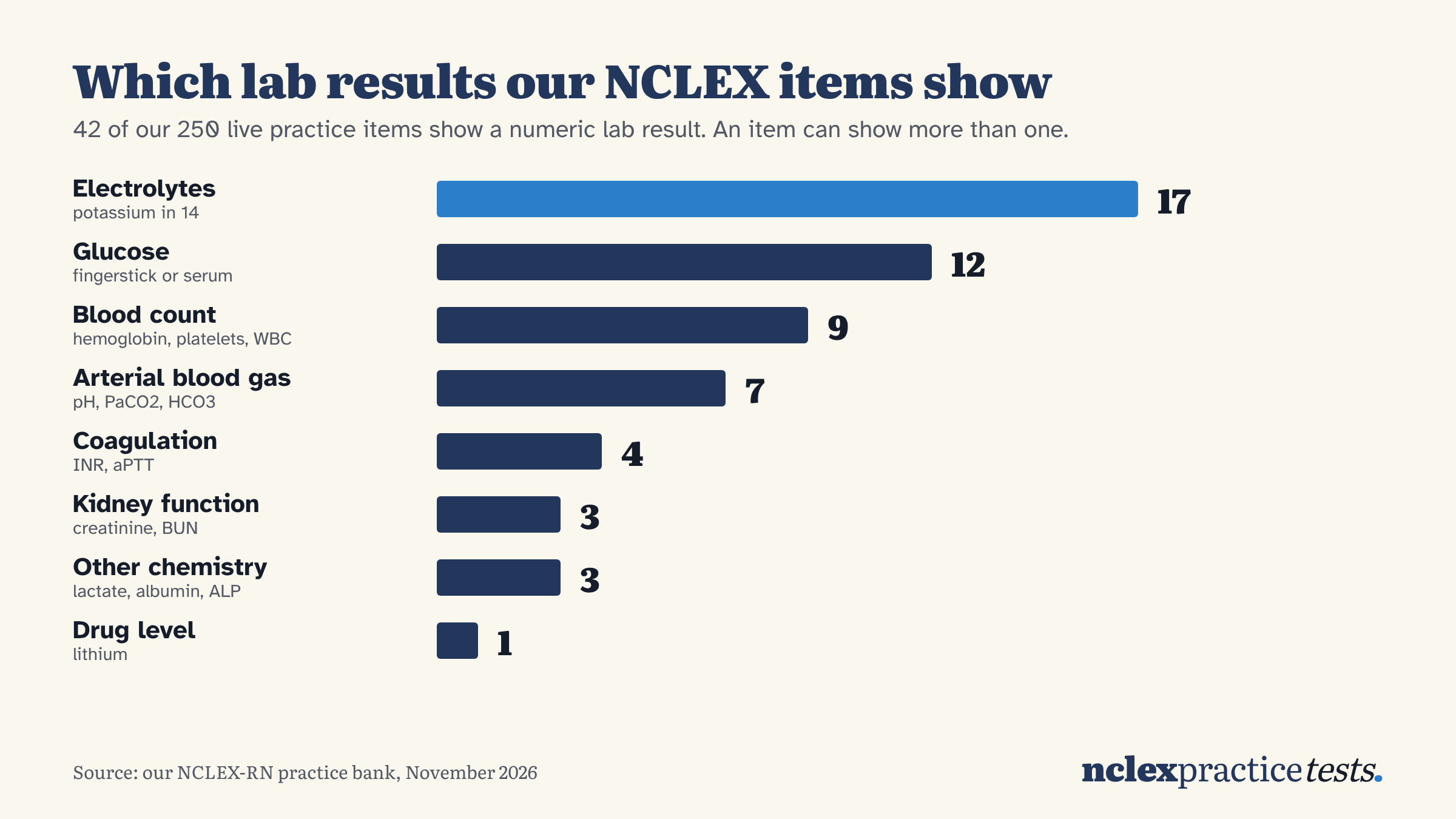
This guide gives the commonly taught adult ranges in one table with the sign and the first action for each. Then it works through three of the 42 items in our bank that show a lab result. All of them are free on our NCLEX practice tests.
Does the NCLEX give you the normal ranges?
Yes. NCSBN’s Next Generation NCLEX FAQ for candidates answers the question directly: “items that contain a numeric lab value will include the corresponding normal reference range.” The same FAQ says items mix SI and imperial units, in the unit a nurse would find familiar.
The 2026 NCLEX-RN Test Plan puts a “Laboratory Values” group of activities under Reduction of Risk Potential. Those include comparing a client’s values to normal values, monitoring them (its example is glucose results for a client with diabetes), and notifying the provider about results. Pharmacological and Parenteral Therapies adds one more: review lab results before giving a medicine.
The range is given. The judgment is not. A potassium of 5.2 can be routine in chronic kidney disease. A potassium of 3.1 is urgent in a client on an insulin infusion. The exam scores the second call, not the number.
The lab values to know, with the first nursing action
The ranges below are from Table B2 in OpenStax’s Pharmacology for Nurses, an open nursing textbook. It notes that ranges vary by lab, instrument and population, so the facility’s range wins at the bedside, and the item’s range wins on the exam. The electrolyte signs come from the same book’s electrolyte chapter. The other signs and the actions are the ones our items key.
| Test | Common adult range | What an off value looks like | What the nurse does first |
|---|---|---|---|
| Potassium | 3.5 to 5.0 mEq/L | Low: weakness, cramps, irregular heartbeat, U waves. High: weakness, palpitations, peaked T waves | Check the cardiac rhythm and report. Hold a drug that makes it worse (a loop diuretic when low, spironolactone when high) |
| Sodium | 136 to 145 mEq/L | Low: headache, confusion, weak reflexes, seizures | Check mental status, keep seizure safety, report a fast fall |
| Calcium | 8.6 to 10.2 mg/dL | Low: tingling around the mouth and fingers, cramps or spasms, seizures | Assess the airway and report, above all after thyroid or parathyroid surgery |
| Glucose (fasting) | 70 to 99 mg/dL | Below 70: sweaty, shaky, confused | Awake and able to swallow: 15 g of fast carbohydrate, recheck in 15 minutes |
| Hemoglobin | Women 12 to 16 g/dL; men 14 to 18 g/dL | Falling: fast pulse, low blood pressure, pallor, dizziness | Look for bleeding, check vital signs, report |
| Platelets | 150 to 450 × 10⁹/L (150,000 to 450,000/mm³) | Low: bruising, bleeding gums, bleeding at sites | Report before any invasive procedure; bleeding precautions |
| White blood cells | 5,000 to 10,000/mm³ | High: infection. Very low neutrophils: infection risk with few signs | Report with the other sepsis cues; protect a neutropenic client from infection |
| Creatinine | Women 0.5 to 1.10 mg/dL; men 0.70 to 1.30 mg/dL | Rising: less urine, fluid gain | Track urine output and report a rise from baseline |
| BUN | 8 to 20 mg/dL | High with dehydration or kidney failure | Read it beside the creatinine and the fluid status |
| PT / aPTT | 11 to 13 seconds / 25 to 35 seconds | Long: bleeding risk | On heparin, follow the aPTT protocol; report bleeding |
| INR | 0.8 to 1.2 (not on warfarin) | High: bleeding risk | Above the target on warfarin: hold the dose and report |
Two small traps sit in the table. The serum bicarbonate on a chemistry panel uses a slightly different range (23 to 28 mEq/L in the same table) than the HCO3 on a blood gas (22 to 26 mEq/L). And “normal” for INR means a client who is not anticoagulated. On warfarin, the goal is higher on purpose.
Glucose: the lab value with a fixed first step
The CDC defines low blood sugar as below 70 mg/dL and severe low blood sugar as below 54 mg/dL. Its treatment page gives the rule our items use: have 15 grams of carbohydrate, wait 15 minutes, recheck, and repeat if the level is still below 70.
Our Exam 1 tests it twice. One item gives a fingerstick of 52 mg/dL in a client who is awake and can swallow, and the answer is 15 g of fast carbohydrate, never the scheduled insulin. The other gives an assistant reporting a glucose of 42 in a sweaty client. The answer is to assess the client now, not to hand the decision to the assistant.
Drug levels: where the “normal” range moves
For drugs watched by a level, the useful number is the therapeutic target, not the normal range. These are from the same OpenStax textbook.
| Drug | Test and target | The NCLEX cue |
|---|---|---|
| Warfarin | INR, goal usually 2 to 3; 2.5 to 3.5 for some mechanical heart valves | Above the goal: hold and report. Vitamin K reverses it |
| Heparin infusion | aPTT, goal typically 1.5 to 2.5 times the baseline, checked about every 6 hours | Above the goal with no bleeding: follow the protocol to hold and restart lower |
| Lithium | Serum level, initial goal 0.6 to 1.2 mEq/L | 1.5 to 2.5 mEq/L: lethargy, tremor, nausea and vomiting. Hold and report |
| Digoxin | Apical pulse for 1 minute, digoxin level, potassium | Pulse below 60: hold. Low potassium makes toxicity more likely |
The lithium item on Exam 3 gives a level of 1.9 mEq/L with a coarse tremor and vomiting: hold the drug and call. For the full list of what to check before each drug class, see the NCLEX pharmacology cheat sheet, which also works a digoxin item where the potassium is 3.1.
ABGs in three steps
Arterial blood gases show up in seven of our lab items, and four give the full pH, PaCO2 and HCO3. The method below answers all of them.
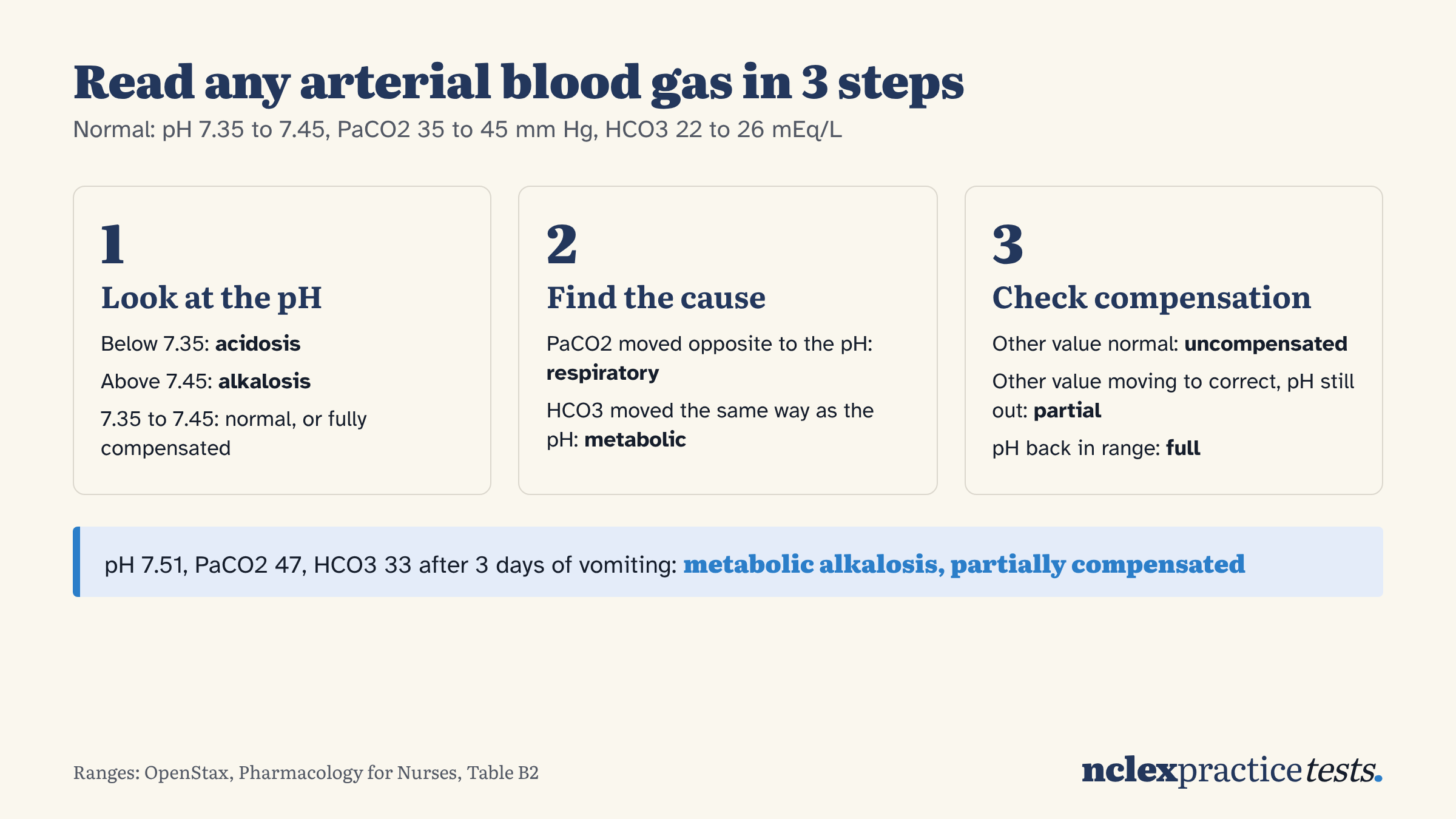
- Look at the pH. Below 7.35 is acidosis. Above 7.45 is alkalosis.
- Find the value that explains it. Carbon dioxide is an acid, so a respiratory problem moves the PaCO2 opposite to the pH. Bicarbonate is a base, so a metabolic problem moves the HCO3 the same way as the pH.
- Check compensation. If the other value is normal, it is uncompensated. If the other value has moved to push the pH back but the pH is still out of range, it is partially compensated. If the pH is back in range, it is fully compensated.
Then ask what caused it. Vomiting loses stomach acid (metabolic alkalosis). Opioids slow breathing (respiratory acidosis). Anxiety speeds it up (respiratory alkalosis). Diabetic ketoacidosis adds acid (metabolic acidosis).
Worked question: three days of vomiting
This item is on Exam 6 and in the med-surg practice questions.
A client has vomited for 3 days. Arterial blood gas results: pH 7.51, PaCO2 47 mm Hg, HCO3 33 mEq/L. Complete the sentence: The results show [metabolic acidosis / respiratory acidosis / respiratory alkalosis / metabolic alkalosis], [fully compensated / partially compensated / uncompensated].
Answer: metabolic alkalosis, partially compensated. The pH of 7.51 is alkalosis. The HCO3 of 33 is high, the same direction as the pH, so the cause is metabolic: vomiting removed stomach acid. The PaCO2 of 47 is high, which is the lungs holding on to acid to bring the pH down. The pH is still above 7.45, so the compensation is partial.
Same direction, metabolic. If the pH and the HCO3 point the same way, the problem is metabolic. If the pH and the PaCO2 point opposite ways, it is respiratory.
What our 42 lab items test
Our bank has 250 original items live on the practice pages. Forty-two of them show a numeric lab result. Potassium is in 14 and glucose in 12, so those two are worth knowing cold. Forty-one of the 42 sit on the eight full practice exams, from one on Exam 3 to eight each on Exams 5 and 7.
The test plan files lab activities under Reduction of Risk Potential. Our lab items spread wider than that: 12 are Pharmacological and Parenteral Therapies, 11 Physiological Adaptation, 10 Reduction of Risk Potential, 8 Management of Care and 1 Safety and Infection Prevention and Control. A lab value is a cue inside many kinds of question, not a topic of its own.
The clearest pattern is in the “who should the nurse see first” items. Six of them include a client whose only problem is an abnormal lab that is expected for the condition: a glucose of 212 to 238 mg/dL before a meal in type 2 diabetes, or a potassium of 5.1 or 5.2 mEq/L in chronic kidney disease. That client is never the answer in any of the six. The answers are airway, breathing and circulation problems, as our prioritization guide explains: a new or unexpected change beats an abnormal but expected finding.
The pattern flips when the whole question is labs.
Worked question: four potassium and INR results
This item is on Exam 5 and the prioritization practice questions.
The nurse receives the 0600 laboratory results for four clients. Which client should the nurse see first?
- A. A client with atrial fibrillation who takes warfarin. INR 2.7.
- B. A client with chronic kidney disease who is not on dialysis. Potassium 5.2 mEq/L.
- C. A client with diabetic ketoacidosis on an insulin infusion. Potassium 3.1 mEq/L.
- D. A client with heart failure who takes furosemide. Potassium 3.6 mEq/L.
Answer: C. Insulin moves potassium into the cells, so this level will keep falling while the infusion runs. The 2024 consensus report on hyperglycemic crises in adults says insulin is delayed until potassium is above 3.5 mEq/L. An INR of 2.7 is within the usual warfarin goal of 2 to 3. A potassium of 5.2 is only mildly high and common in chronic kidney disease, so it can wait. A potassium of 3.6 on furosemide is in range.
In range is not the same as safe
Some items turn on a value that is normal for one purpose and dangerous for another.
Worked question: an INR before surgery
This item is on Exam 6 and in the pharmacology practice questions.
A client is scheduled for an elective hip replacement this morning. The client takes warfarin for atrial fibrillation and says the last dose was taken last night. The INR drawn this morning is 2.6. What should the nurse do?
- A. Notify the surgeon of the INR before the client goes to the operating room
- B. Send the client to surgery, since the INR is in the target range for atrial fibrillation
- C. Give vitamin K by mouth now and send the client to surgery as scheduled
- D. Hold this morning’s warfarin dose and send the client to surgery as scheduled
Answer: A. An INR of 2.6 is right for atrial fibrillation, which is exactly the problem: the client is fully anticoagulated, and major surgery usually needs an INR close to normal. B treats “in the target range” as “safe for anything.” C needs a provider’s order, and vitamin K by mouth takes many hours to lower the INR. D does not lower today’s INR: the OpenStax textbook notes that warfarin’s effect can last 5 or more days after it is stopped. The surgeon decides whether to delay or reverse, so the nurse reports first.
The same idea runs through our pre-procedure items. A platelet count of 42,000/mm³ before a liver biopsy, a potassium of 2.9 mEq/L before an elective gallbladder surgery, and a potassium of 6.6 mEq/L on the morning of dialysis are each the one result to report before the client goes. All three are in the med-surg practice questions.
Practice next
Work the electrolyte and acid-base items in Study mode on the med-surg practice questions, then sit Exam 5 timed, where eight of the 30 items show a lab result. Transfusion questions use the hemoglobin too, and blood transfusion reactions covers them. To fit labs into a schedule, the NCLEX study plan puts Reduction of Risk Potential and Physiological Adaptation in week 3. This is exam preparation, not clinical guidance: use your facility’s ranges and protocols at the bedside. The NCSBN, OpenStax, CDC and consensus documents behind this guide are listed on sources, and more guides are on the study guide.
Frequently asked questions
Does the NCLEX give you lab values?
Yes. NCSBN's candidate FAQ says items that contain a numeric lab value include the corresponding normal reference range. Units are a mix of SI and the imperial units nurses use. The skill being tested is deciding what the value means for this client and what to do about it.
What is a normal potassium level?
The commonly taught adult range is 3.5 to 5.0 mEq/L, the range in the OpenStax Pharmacology for Nurses table. Low potassium causes weakness, cramps and an irregular heartbeat. High potassium causes weakness and palpitations, with peaked T waves on the ECG. Either one can cause dangerous dysrhythmias.
What are the normal ABG values?
pH 7.35 to 7.45, PaCO2 35 to 45 mm Hg, HCO3 22 to 26 mEq/L, PaO2 75 to 100 mm Hg and SaO2 95% to 100%, per the OpenStax table. Read the pH first, then find which value moved with it, then check compensation.
Which lab values are most important for the NCLEX?
Potassium, glucose, sodium, hemoglobin and platelets, the coagulation tests (INR and aPTT), arterial blood gases, creatinine, and the drug levels for lithium. In our own bank, potassium appears in 14 of the 42 items that show a lab result, and glucose in 12.
Do I need to memorize lab values for the NCLEX?
Learn the common ranges well enough to spot a value that is off without looking, because it saves time. The exam still prints the range with every numeric lab value. What you cannot look up is whether the value is expected for the client's condition, whether it is changing, and what the nurse does first.
Built and maintained by the NCLEX Practice Tests team. Items are original and checked against the published test-plan categories before they go up. Each rationale is reviewed before publish. These are study questions, not official NCSBN items and not medical advice. About this site →